Vortex Mist Collectors
Transcript of Vortex Mist Collectors:
Hello, and welcome back my friends. As you can see I’m with Dan the man again today. This guy is always teaching me something new. I’m at Edge Technologies as well and Edge, as you guys know, is world famous for being leaders in bar feeders. And we’re going to talk about that from time to time as well but not in this episode. In this episode, I’m standing in front of some pretty cool technology which is filtration units of different types.
Now, personally, I’m not as educated as I would like to be on filtration units. So for those of you out there who are, or those who are a lot like me and want to learn a bit more, I think this is the video for you. And Dan is the guy to talk about it. Dan, thank you again for joining me on MTD.
Yeah, of course. Just to reiterate what we were talking about: the shop I came from and the shop you said you came from had zero mist collection in it, so I didn’t know a whole lot about it either, to be honest, until I got on board here at Edge. So I hit the books hard, and now I know a thing or two, but also how important it is to be in shops that care about their air quality, and how it can help employee retention and safety for your machine tools and your shop floors, keep them a little drier, not as slick — really a lot of added benefits to adding filtration to your machine tools.
I can agree with that from a broad perspective, outside looking in, exactly what you just said, Dan.
We didn’t have them in our machine shops, and now, doing a lot of interviews and going into factories, I’ll walk in and you can see the smog. You can even taste the smog and a machine shop smell and feel. It’s kind of something we’re used to. However, I’ve also walked into shops where it’s as clear as it is in this shop.
So let’s talk about the technology and benefits of these two units we’re standing in front of right now.
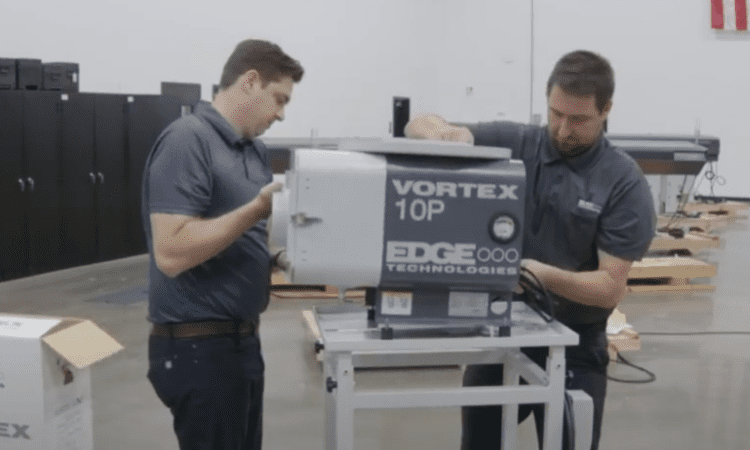
Sure. So you see there’s two major different players in the mist collection line. We have, over behind Tony here, that’s our AF series. That’s for water soluble coolants, so that’s on your typical mills, your standard lathes, typical water soluble coolant applications. So we actually have this unit in four different sizes. We have an AF10, 20, 30, and 40. And all of those go to sizes of different machine tools. So an AF10 would be on a smaller conventional lathe, all the way up to an AF40, where we would go with a pretty big long-bed milling center or a long turning center.
And also, what we’ve done on some longer turning centers is multiple smaller units, maybe a smaller unit in each corner, depending on where you’re working along that lathe, where your mist might be coming from. So maybe it’s more important to have a couple different units extracting from different areas rather than just trying to pull the full length of a lathe itself. You know, your unit on one side and your mist at the other—a lot of work bringing it down the line.
And then we have a little bit different with our OS Series. So this is for your hard cutting oils, typically in a Swiss machining application or grinding—we see those. This is a one-size unit. It kind of lends itself to a Swiss-size lathe, a little more small footprint. However, the cutting oil itself is much harder to collect. It’s much finer. The mist is much finer, so this has got a fiber bed filter in it. It’s got 60 square feet of fiber filter in it wedged into a really, really small footprint, and it’s that density that really allows us to collect a really fine mist created by that Swiss machining hard oil cutting process.
That is interesting. So I’m standing in front of between the two, and by all means let me convey the message: this is not overwhelmingly loud, but between the two, that one’s pretty much silent, sure, and I do hear a little bit of a hum from this one, right? What’s the difference between those two? Is that because of the processes that is creating for the customer?
Correct. So, this unit here — that’s more of our between our AF20 and our AF30 size — so that is made for a machine tool that would be much bigger than this cabinet, whereas this one is sized for about a machine tool this size, maybe a little bit bigger. And the noise that you’re hearing, while you typically can’t hear it over an ambient shop setting — we are kind of in a quiet environment here, so it might play a little more on the ears—that is because we’re using this one to extrapolate much quicker, much harder. So you need a little bit bigger vacuum to pull it out, so it would be something you hear a little bit more. However, that is the machine working appropriately.
Yeah, I wouldn’t be able to hear this over a machine cutting for sure, but we are in a silent area, so it was worth bringing it up now.
Definitely.
We obviously have a pretty cool display in between us, and I know the audience has been watching this as we’re talking the whole time. Some have probably assumed or already know what’s happening here, but would you mind explaining what this little smoke bomb that we’ve created here is doing?
Yeah. So what we did is, it’s hard to replicate a machine tool, and we take this to shops and demo it all the time, where we can’t necessarily show up on their equipment and say, hey, install this. So we have a little smoke-and-mirrors box where it’s showing, say you’re processing a part, you’re doing some deep hole drilling, you’re really, really kicking up a lot of mist, high-pressure systems that everyone’s seemingly going to. So we can fill this whole cabinet up with the mist here, and then I’ll kill it, and you can see how quickly it gets extrapolated from your machine tool and not really coming out of the units themselves, because it’s doing a job collecting all of that mist and releasing pure, really high-quality air back into your shop, protecting your operators, your engineers, and everyone on the shop floor.
So I have to ask — and maybe it’s different from the setup of demos, because oftentimes we push things to extremes to showcase how cool it can be or how amazing it can be for a person’s shop — but as a general rule, if I’m invested in either one of these machines, and maybe there’s a difference, so if there is, please convey that difference, sure, but how often do I need to change the filtration between the two systems when I’m pulling in all this contamination?
Great question, because when we’re talking about mist collecting, we are talking about consumables a lot of the time. The great thing about the AF series, like I said, water soluble, a little easier to collect. There’s two filters in that setup. So the first-stage filter is a completely washable filter, so you’re never replacing that.
Very handy.
The one sitting on top is the HEPA-grade filter. Water solubles, high-pressure coolant — we’re talking more than a year plus replacing those. I typically see two to three years from people running pretty much 24/7 before they’re having to replace that filter.
Over here, the OS series actually has four filters in it. It’s got two mechanical filters in the lower side here, completely washable, as in the AF series. The big filter that sits in the middle — that’s the fiber bed filter we spoke about. You’re getting a year plus off of that on typical oil cutting. And then the HEPA filter as well that sits on that—that’ll be about the same lifespan as that fiber bed filter, typically around a year for those.
And are we allowed to mention what a cost would be after that year to replace the filter?
Yeah.
So they’re both around — the filter on the HEPA up there — around 500, and the fiber bed filter here is between five to seven, depending on what setup we have for you.
I’ve heard this statement said before, but what a perfect segue to go, well, how expensive are your lungs?
Well, that’s good. For how important is the internal components of your body when breathing in the contamination that you and I already did, right, versus investing in something like this — exactly. And employee retention, safety, and safety of your equipment. Oil and electrical components, electrical boxes, is not a great combination either. And a little bit younger generation — we are kind of thinking a little bit more about air quality. What we went through the last couple years, right? Everyone’s kind of thinking about it a little bit. For a relatively affordable investment into your shop, we can really clean things up for you.
Well, you’ve now reminded me of three more things I want to talk about to close out the conversation. The first one, then, you mentioned this: people coming into facilities now. There are a lot of times they’re attracted by new technology or exciting technology, but they would also be very attracted to clean air, a clean working environment.
Definitely. Now, that is when we’re talking about negotiating one person between five or six shops — sometimes that’s the winner.
And the other two thoughts are: there are two people, or two sets of people, I would say, that are out there right now. One who have already invested in this because they believe that they need it, and two who don’t think that they need it because it’s good enough, or I’ve opened my back doors, or my windows in my garage. Can we address those two different audiences in a unique way to say, if you’ve already invested, maybe this is why you should invest in Edge, right? And if you haven’t invested, even though we’ve kind of discussed it a little bit, just one final focus on: man, we both worked in machine shops that didn’t have it. This is probably why we should look into it. It’s not that expensive, it pays for itself, and it brings in new employees.
Right. Well, yeah, we’ll go one at a time. The shop that already has them — the good thing about the two units that we bring in here at Edge — very, very low maintenance. What I’ve noticed is there are shops that do have mist collectors. They run them. They can hear them humming. They’re running good. But how often do you look at your filters? How often do you clean them? Let’s be real — not very often. So we’ve found two products that both require very, very little maintenance to run flawlessly and actually do their jobs, rather than, yeah, I can hear them running, I guess they’re doing what they’re supposed to. But if they’re never cleaned, maybe they don’t. So we kind of came to the reality that shops don’t have the time or the manpower to be cleaning these things all the time. We understand that, and we’re pretty honest about it. Yeah, I will tell you, the more you clean the first-stage filters in these units, the longer your HEPA filters will last.
That’s true. Also knowing it’s not exactly the number-one priority for all shops, so you do get quite a bit of longevity even without the constant maintenance of the units.
To the second example, you have the shops who don’t have any mist collection, i.e., the shops we were coming out of. You can get away with it for a while, but what we’re all battling for is the same people. And if you just made a big investment on a new machine tool, for the price you put into that machine tool, to keep everything clean — the machine tool itself, the people operating it — it’s such a small drop in the bucket comparison and such a low effort. I don’t want to sell a no-brainer, but it’s really smart to go with some sort of mist collection solution to improve everything around your shop environment.
Very well said, Dan. A lot of us get so focused — and I think it’s important to remain focused — but so focused on if we’re not making chips, we’re not making money. But there’s so many accessories that go into surrounding that to make it the right environment to keep the machines running as well and to keep the people happy. Exactly. This, to me, is one of those things — or two of those things in this specific case. Yeah, we agree. We agree. And, yeah, keeping people healthy, happy, keeping people clean — you know, that’s the name of the game.
Awesome, Dan. Well, thank you so much.
Thank you.
Thank you all for watching. This is pretty cool technology. I’m happy to talk about it and bring it to the audience. It’s not something we get to talk about every day. And I have to ask you one last question before we go. Have you ever opened a machine and then all that smog just comes straight to you?
Oh yeah. Yeah, all the time. All the time. You get the nice steamy shower, the little shower, the exfoliating coolant mist, which smells excellent. Everybody knows that it smells. Everyone knows that, because we’re taking great care of our coolant too, right guys?
Oh yeah, always.
Dan, thank you again. Thank you all for watching. Thank you for watching MTDCNC. This is Edge Technologies.